
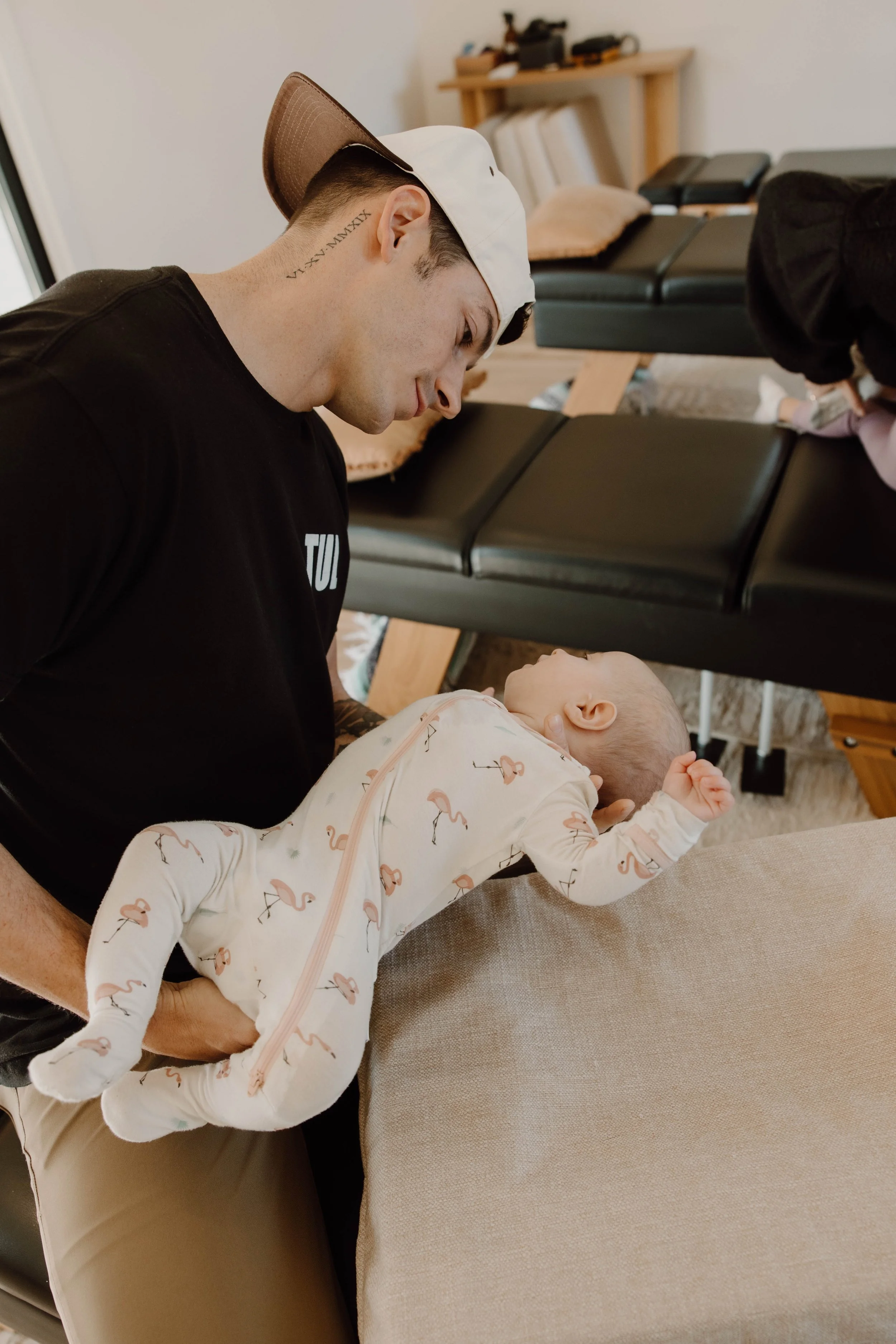
Infant Torticollis Treatment in Tulsa - Gentle Chiropractic Care for Your Baby

You've noticed your baby's head always tilts to one side. Maybe they resist turning in a certain direction, or breastfeeding only works comfortably on one breast. If your pediatrician has mentioned "torticollis," you're likely wondering what comes next.
Torticollis is one of the most common musculoskeletal conditions in infants, affecting approximately 1 in 250 babies. With early intervention through gentle chiropractic care, most cases improve significantly — often in just a few weeks.
At Free Spirit Chiropractic, our pediatric chiropractors specialize in safe, neurologically-focused care that addresses the root cause of your baby's torticollis.
What Is Infant Torticollis?

Torticollis — meaning "twisted neck" — occurs when tightness or dysfunction in the cervical spine causes your baby to hold their head at an angle. The most common form involves tightening of the sternocleidomastoid (SCM) muscle, which runs from behind the ear to the collarbone.
Signs your baby may have torticollis:
A consistent head tilt to one side, even at rest
Difficulty or resistance turning their head in one direction
Preferring to feed on one side only
A flat spot developing on one side of the head (positional plagiocephaly)
Fussiness during tummy time or certain positions
Asymmetry in facial features or head shape
Common causes include cramped in-utero positioning, birth trauma from prolonged labor or assisted delivery (forceps, vacuum, C-section), and upper cervical subluxation at the junction between the skull and first vertebra. When torticollis goes unaddressed, it can lead to plagiocephaly, delayed motor milestones, and chronic postural imbalances.
How Chiropractic Care Helps Torticollis
Our approach goes beyond stretching the tight muscle — we address the spinal and nervous system dysfunction driving the restriction.
Gentle Cervical Adjustments
Using fingertip pressure no heavier than what you'd use to check a tomato for ripeness, we restore joint mobility in the upper cervical spine. These low-force adjustments reduce muscle tension and allow your baby's nervous system to properly regulate head position and movement.
Craniosacral Therapy
This gentle technique works with the cranial bones and fascial system, helping guide bones back into optimal alignment after the compressive forces of birth.
Full-Body Assessment
We evaluate the entire spine, shoulders, and pelvis to identify compensatory patterns contributing to your baby's restriction. A comprehensive approach leads to more complete, lasting results.
Soft Tissue Release
Gentle myofascial techniques address SCM tightness, improving range of motion without aggressive stretching.
A published case report documented near-complete resolution of infant torticollis after just three chiropractic treatments over four weeks, with no recurrence at 26-month follow-up.
Supporting Your Baby at Home

Tummy time several times daily to strengthen neck muscles and encourage turning both directions
Encourage the restricted side with toys, your voice, and positioning during play
Alternate feeding positions to use both sides of the neck equally
Vary head position during sleep (always on back), car seat time, and carrier use
Gentle stretches during happy, alert moments — we'll teach you playful techniques that feel pleasant, not forced

Related Conditions
Torticollis often coexists with plagiocephaly, infant colic, breastfeeding difficulties, sleep issues, and birth trauma effects. Addressing torticollis early often improves several of these simultaneously.
Find Torticollis Relief in Tulsa

Free Spirit Chiropractic is located at 4312 E 51st St in Tulsa, serving families throughout Midtown Tulsa, South Tulsa, Brookside, and Broken Arrow.
Frequently Asked Questions
-
From the very first days of life. The sooner it's addressed, the faster it resolves and the less likely secondary complications like plagiocephaly will develop.
-
Not at all. Pediatric adjustments use less pressure than pressing a key on your phone. Our techniques are specifically designed for infant anatomy.
-
Many families see meaningful improvement within two to six visits. Mild cases may resolve quickly, while more established torticollis may need a longer plan with at-home exercises.
-
We do not accept insurance. We offer transparent pricing and can provide superbills for potential out-of-network reimbursement.